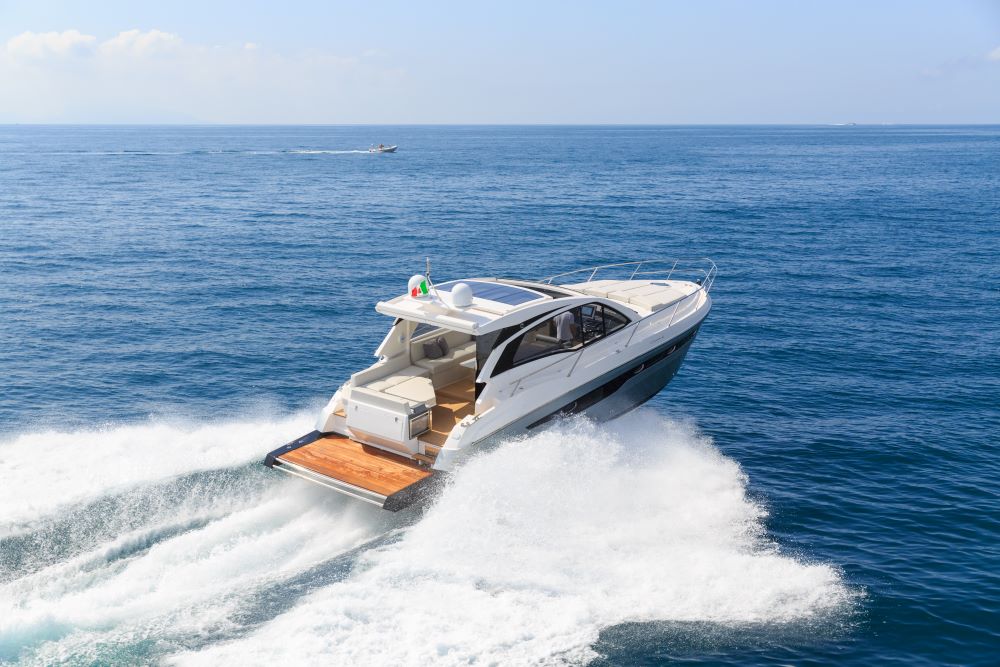
Moteur inboard : comment fonctionne le moteur intérieur d'un bateau ?
Updated April 2025 If you’re considering getting a motorboat to spend your summer on the water, you probably already know that there are a few different types of engines to choose from.
Some motorboats have outboard engines, while others are equipped with inboard engines. Each type has its own advantages and disadvantages and is suited for different boating activities.
Keep reading tofind out more about inboard engines.
How does a boat motor work?
A boat engine essentially works by converting fuel into thrust to propel your vessel. Inside the engine, fuel and air are ignited in cylinders, pushing pistons that spin a crankshaft. This rotational power is then transferred through a driveshaft and gearbox to a propeller (or a jet drive), which pushes water backward to move the boat forward. All the while, a cooling system prevents overheating, and steering mechanisms allow you to control your direction.
What is the difference between an inboard engine and an outboard engine?
Unlike outboard engines, which are mounted on the outside of a boat (usually at the stern), inboard engines are installed inside the hull, either in the bilge or in an engine room for larger vessels.
While outboard engines are used to power and steer the boat, inboard engines require one or more rudders for steering, located behind the propeller that drives the boat. When turning, an inboard engine will not pivot like an outboard engine does. Therefore, a boat with an inboard engine will always be steered with a wheel rather than a tiller.
Boat propulsion with inboard engines
Generally speaking, inboard engines are four-stroke engines (much like car engines) that power a drive shaft running through the bottom of the hull. The drive shaft is connected to a propeller that spins to propel the boat. The faster the propeller spins, the more the boat will accelerate.
Types of inboard engines
Inboard engines are always installed inside the boat. There are a few different types of inboard engines—the main ones are direct-drive (D-drive) and V-drive.
Direct drive (D-drive) inboard engines
Direct drive inboard engines are fairly common propulsion systems. In D-drive systems, the engine faces aft and is connected to a drive shaft that protrudes out the bottom of the boat. The drive shaft is a straight rod with a propeller at the end that drives the boat.
This type of drive minimizes engine power loss, and its simplicity makes it highly reliable. However, direct drive inboard engines may need to be placed further forward in the boat, reducing the amount of space available for the cabin and seating.
V-drive inboard engines
Unlike direct drive, a V-drive inboard engine faces forward and has a transmission that redirects the drive shaft towards the stern, creating a V shape. The drive train at the bottom of the boat is similar to a D-drive inboard system, with a shaft connecting to a propeller.
This configuration often provides more space in the cabin or additional seating, because the engine is placed further back in the boat. Unfortunately, some efficiency is lost between the engine and the propeller due to the change in direction.
Other types of inboard engines
There are other types of engines that can also be considered inboard engines.
Hydro-jet engines, which are commonly found on jet-skis and small speedboats, use a turbine instead of a propeller.
There are also Z-drive engines, which are a sort of inboard/outboard hybrid. Rather than having a fixed propeller and rudder, the engine block inside the hull is connected to a base plate similar to an outboard engine. The base plate is equipped with one or two propellers. When turning, the base plate will pivot, guiding the boat in the desired direction.
Why opt for an inboard boat engine?
Inboard engines are very popular with boaters who enjoy water sports. They create great wakes for waterskiing and wakeboarding. Some boat models designed specifically for wakeboarding even come with ballast to create different types of waves.
The propeller is located under a platform at the stern, which is safer for people being towed behind the boat, reducing the risk of propeller strikes.
Many boaters also appreciate the fact that inboard engines are quieter than outboard ones, making it easier to follow boat pollution regulations linked to noise.
Additional information about inboard engines
Are you convinced that you want a boat with an inboard engine? Here’s some more information to help you make an informed choice.
Cost
Inboard engine boats are generally more expensive than boats with outboard engines.
They can also cost more to insure.
Weight and size
Inboard engine boats are generally larger and heavier than boats with outboard engines, making them more difficult to transport.
They also require more storage space.
Maintenance
Inboard engines are generally located in the bilge. Even if bilge pumps are working, humidity and the occasional splash or leak can expose the engine to moisture. Opening the engine compartment for maintenance and to clean the fuel tank further exposes it to this environment, increasing the risk of corrosion and damage to electrical components or other sensitive parts. Their location also makes them more difficult to access than outboard engines.
Nonetheless, maintenance is essential, because mechanical problems can potentially cause an engine fire that could spread throughout the boat due to the position of the engine. That’s why it’s important to follow all boat fire extinuisher regulations.
Operation
Due to their configuration, inboard engine boats are also more difficult to dock.
Learn more about boating at the National Boating Safety School
We hope this article has helped you learn more about inboard engines and how they work.
Remember that in order to comply with Canadian boating laws and regulations, you need to have your Pleasure Craft Operator Card with you at all times. Sign up to take our Transport Canada approved boating safety course, so you can challenge the exam and get your official proof of competency today! Invite your family and friends to make the most of our group discounts. Boating safety is for everyone.